

Maamoul Cookies Recipe
Maamoul is a delicious traditional Middle Eastern cookie that is typically made on religious holidays such as Easter or Eid. What makes maamoul distinct are the subtle flavorings used in the dough and in the filling, including “Mahlab” aka Mahlepi an aromatic spice, rose water, orange blossom water, mistika, and in some cases acacia incense. Here is the complete Maamoul Cookies Recipe.
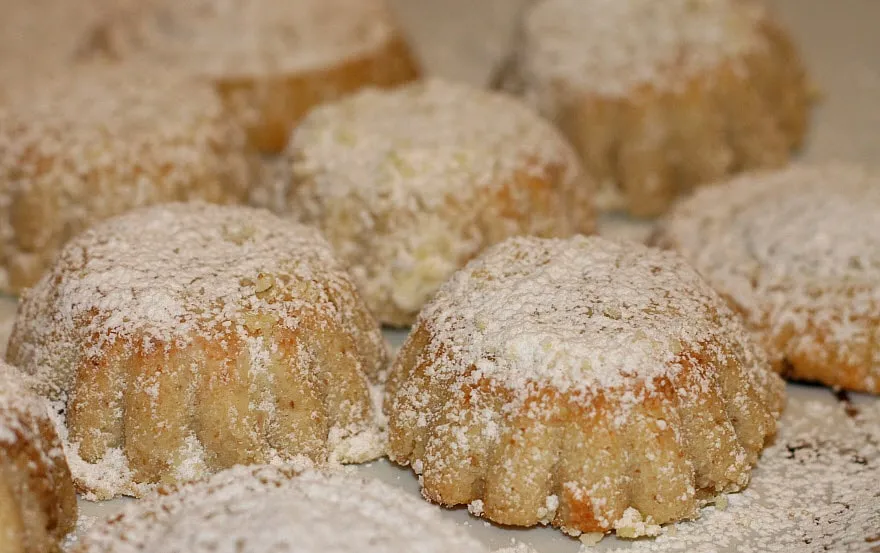
How To Prepare Maamoul Recipe Walnut
Maamoul’s paste is prepared from semolina (aka “smeed” in Arabic) which is the coarse, purified wheat middling of durum wheat. Coarse semolina is typically a bit yellowish in color and is known as “smeed khishin” in Arabic, or coarse “smeed”. Fine semolina is another ingredient in Maamoul and can be known as “farina”, or in Arabic “smeed naaim” or fine “smeed.” Such ingredients are typically found in local Arabic grocery stores, or can also be found in Mama’s online store or on Amazon. Note that in our first batch of Maamoul we did not use Farina, but just coarse semolina, and the taste turned out fine. So if you’re not able to find Farina just stick to coarse semolina and don’t sweat it. We also heard of some chefs baking maamoul using only farina, with no semolina.

Mamoul bi Joz w Fustuk Fillings
Maamoul fillings can include dates, walnuts, pistachio, or a combination of both or other nuts. Traditionally, maamoul with dates (also called maamoul bi siwa) is made with a round-shaped mold, and maamoul with nuts with an elongated shape mold. Only nuts-filled maamoul gets sprinkled with powdered sugar. Dates-filled maamoul is baked slightly longer to get light brown cookies, whereas nuts-filled maamoul is removed from the oven at the slightest hint of browning.
Making Maamoul Using a Traditional Wooden Mold
Traditionally home-made Maamoul is molded using a wooden mold. In the US such molds can be purchased at Arabic grocery stores, or can also be found online for around $4-5. A piece of dough that is a bit smaller than a golf ball is placed in the palm of the hand, flattened, fillings is placed in its center and the dough is then closed by folding the edges over the fillings. It’s then placed inside the mold, flattened and the mold is slammed against a cutting board a couple of times until the dough falls nicely shaped to the mold.


Making Maamoul Using a Muffin Mold or Cookie Cutter
Since many people don’t have the traditional wooden mold, we tried making maamoul using regular cookie cutters or muffin molds and it worked nicely. Using a muffin mold, flatten a piece of dough inside it all along the edges to a thickness of about 1/3 inches or less, then about 1 teaspoon of fillings is added in the center and is then covered by another piece of dough that is made flat with the edges of the mold. The mold is than slammed against a cutting board a couple of times until the dough falls. You can also prime the mold with some butter to make the cookie fall easier.


Mama tried dozens of maamoul recipes over the years and settled on the one we’re featuring in this post. We followed her instructions and got the recipe right in the first shot, and gained a few pounds in the process. This recipe should yield about 25 to 30 maamoul cookies that are about 1.5 to 2 oz each.

Lebanese Mamoul Recipe - Pistachio Stuffed Cookies with Rose Water
Equipment
Ingredients
Mamoul Dough
- 1 lb semolina coarse
- 5 oz semolina fine
- 0.5 cup sugar
- 0.6 lb sweet butter melted
- 4 oz rose water
- 1 oz orange blossom water
- 1/6 teaspoon yeast
- 1/4 cup water warm
- 1/2 teaspoon mahlab ground, optional
- 1/4 teaspoon mastic gum
Nut Fillings
- 3/4 cup sugar
- 2 cups powdered sugar
- 0.5 lb pistachio unsalted, raw or roasted, crushed
- 0.5 lb walnuts crushed
- 1 oz rose water
- 1 oz orange blossom water
Instructions
Maamoul Dough Preparation
- Mix the coarse and fine semolina, along with 0.5 cup of regular sugar with hands or in food processor.
- Melt the butter on low heat, let cool down, then pour on top of the semolina mix and work it with your hands into a paste. You can also use a food processor for 1-2 minutes on low speed.
- Warm 4 oz of rose water, 1 oz of orange blossom water in a pot along with the mastic gum and pour on the paste.
- Dilute the yeast in 1/4 cup of warm water and add to the paste.
- If available, add a dash of Mahlab powder and knead the dough with your hands, or in the food processor for 3-5 more minutes.
- You should now have a nice dough that needs about 7-10 hours of rest, covered, at room temperature.
Mamoul Fillings Preparation
- Mix your choice or pistachio, walnuts, or a mix of both along with sugar in a food processor and grind at high speed for 2-3 minutes
- Add the rose water and orange blossom water and grind for a couple more minutes
- Don't grind them too much as you want the filling to still have chunks of nuts, and not turned into a paste
Shaping the Maamoul With a Mold
- Flatten 1 tablespoon of dough into a 1/3 inch thickness.
- Add 1 heaping teaspoon of fillings to its center, then wrap edges in to close off the cookie.
- Place the cookie in a buttered wooden mamoul mold, press it gently with your fingers until it becomes flat with the mold surface (add more dough if needed).
- Tap the wooden mold's edge on a cutting board a couple of times until the molded maamoul drops.
- If you don't have a traditional wooden mold, you can use a metal cookie molding/cookie cutter to mold the dough.
- Line up molded maamoul pieces on a semolina-dusted or buttered aluminum foil or cookie tray.
- Bake at 430F for 13-15 minutes, or until the maamoul begins to turn light brown.
- As soon as you take them out of the oven and while still hot, using a tea strainer, sift powdered sugar sift to fully cover the maamouls. The powdered sugar may eventually melt and turn into a glaze, that's fine.
- Let cool down at room temperature, and then sprinkle some more powdered sugar until fully covered.
- Your maamoul is now ready to be devoured. You can keep them in an airtight container for a few days at room temperature or in the fridge.
Notes